















How Can MBR Technology Improve Your Wastewater Treatment Operation?
Membrane bioreactor (MBR) technology combines biological treatment with membrane filtration to produce effluent that conventional processes can’t match, and for facilities weighing their wastewater treatment options, that combination has become less of a specialty choice and more of an industry standard.
Whatever your current wastewater treatment setup looks like, understanding how MBR technology works and what it does differently is the first step in deciding whether it’s the right upgrade.
What Is MBR Technology?
MBR systems integrate a perm-selective membrane—hollow fiber or flat sheet, at microfiltration or ultrafiltration pore sizes—directly into a biological wastewater treatment process, typically a suspended growth bioreactor. In the final stage of treatment, the membrane physically filters organic and suspended solids out of the water at a level conventional clarifiers can’t reach.
The technology has matured substantially since its early adoption in U.S. municipal and industrial markets in the late 1990s and 2000s, driven by tightening discharge standards and growing interest in water reuse. It’s now standard practice across:
- Food and beverage processing
- Pharmaceutical manufacturing
- Oil and gas operations
- Residential and commercial developments
- Small- and mid-sized municipalities
How MBR Systems Work
MBR refines the traditional activated sludge process by replacing the clarifier with a membrane assembly. That swap is what drives the jump in effluent quality: instead of relying on gravity to separate solids from water, the membrane physically blocks them.
A typical MBR wastewater treatment system includes:
- Headworks screen: removes larger debris before it enters the process
- Equalization tank: regulates flow variability so the system isn’t caught off guard by surges
- Treatment basin: houses the membrane unit itself
Engineers work with their MBR partner to size the system to actual flow requirements, and every stage (membrane type, pore size, flux rate, fouling control) has to be matched to the site’s wastewater characteristics and discharge goals. Membrane replacement on a regular schedule is what keeps that performance consistent over the life of the plant.
The Core Components of an MBR System
Every MBR system, regardless of application, is built around the same fundamentals:
Membrane modules. These are the core of the system. Membrane modules house the membranes that separate solids, microorganisms, and contaminants from treated water.
Membranes. Some platforms are membrane-agnostic, meaning the choice of membrane type is a separate engineering decision made in partnership with the client, based on the specific wastewater stream and goals.
Biological treatment tank. Where microorganisms break down organic pollutants before the water ever reaches the membrane, a step shared with conventional treatment, not unique to MBR.
Aeration system. Supplies oxygen to those microorganisms, driving the metabolic activity that breaks down organic matter.
Controls and automation. Modern MBR systems monitor flow rates, dissolved oxygen, and membrane integrity in real time, giving operators the ability to adjust performance on the fly rather than react after the fact. What used to be a competitive edge is increasingly the baseline expectation.
Effluent handling. Because MBR effluent quality exceeds what conventional activated sludge produces, it’s often clean enough for reuse applications, like irrigation, industrial process water, or other non-potable uses, rather than only meeting discharge minimums.
Sludge management. The biological process still produces sludge as a byproduct, and its handling and disposal remain subject to local and state regulation regardless of treatment method.
What Are the Advantages of MBR Technology for Wastewater Treatment?
MBR technology offers several advantages over conventional wastewater treatment, particularly for facilities facing stringent discharge requirements, limited space, variable flows, or water reuse goals. Key benefits include:
- High-quality effluent. Membrane filtration provides a physical barrier for suspended solids and microorganisms, producing consistently high-quality treated water.
- Improved solids and organic removal. MBR systems combine biological treatment with membrane separation to provide a higher level of treatment than conventional clarification.
- Smaller treatment footprint. Replacing conventional clarification with membrane separation can reduce the space required for certain treatment processes.
- Performance under variable flows. MBR systems can provide facilities with greater flexibility when wastewater flows fluctuate or peak.
- Water reuse potential. High-quality MBR effluent can support non-potable reuse applications such as irrigation and industrial process water.
- Support for stringent discharge requirements. The treatment quality achievable with MBR can help facilities address increasingly strict wastewater discharge limits.
Is MBR Right for Your Operation?
That’s the real question underneath all of the above, and it’s worth working through deliberately rather than assuming the answer:
Regulatory compliance. Review the specific limits your facility is held to (turbidity, TSS, BOD, COD, nutrient levels) and check them against what MBR effluent quality typically achieves. In most cases, the gap closes fast.
Wastewater characterization. Know what you’re actually treating. A clear picture of chemical constituents, suspended solids, and organic load shapes every downstream decision about membrane type and system design.
Flow rate variability. Facilities with unpredictable or seasonal flow patterns benefit disproportionately from MBR’s ability to handle peak loads without the performance dips conventional systems experience under stress.
Treatment objectives. Are you discharging to a stream, a sewer, or reusing the water on-site? The end use should shape the system design from day one, not get retrofitted in later.
Modularity and growth. If your wastewater volume or composition is likely to change—such as a growing campus, a phased development, an expanding production line—a modular system can scale with you instead of requiring a rebuild.
Urgency. If you’re facing a compressed timeline (a failed plant, a natural disaster, a regulatory deadline) modular, rapid-deployment MBR systems exist specifically for that scenario, and can be operational in weeks rather than the months or years a conventional rebuild requires.
Two Platforms, Not One Answer
A meaningful shift in the MBR market over the past two years has been the move away from a single default configuration. IWS now offers two distinct platforms, matched to different project needs rather than a one-size-fits-all deployment:
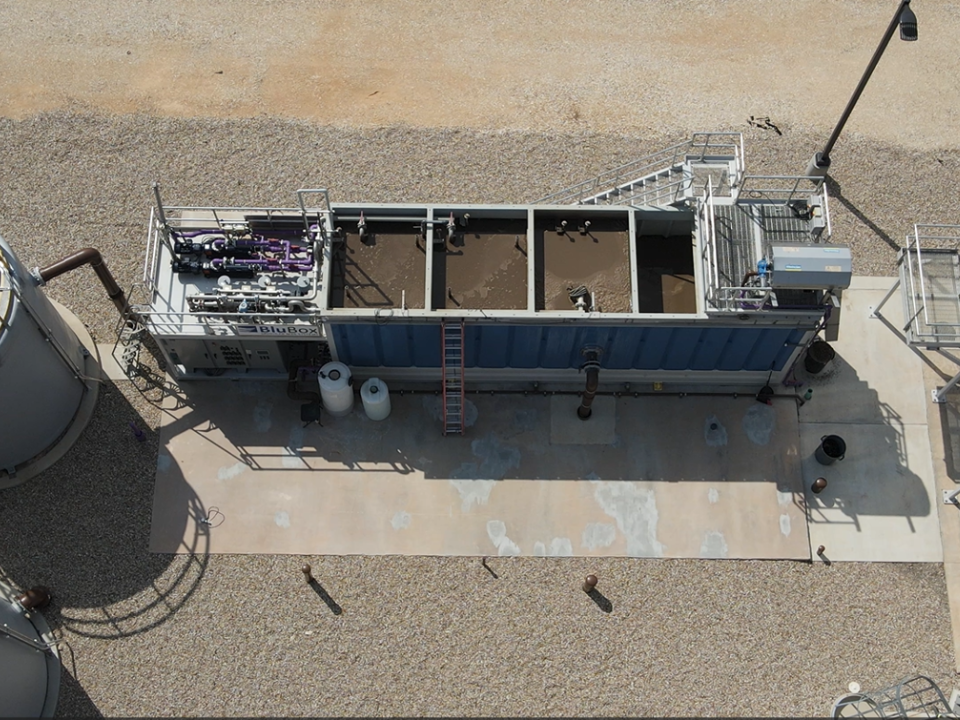
BLU|BOX Modular MBR Systems® — modular, membrane-agnostic, rapid-deployment MBR units built for speed. These are the systems that get a community back to treating wastewater in weeks after a disaster destroys or disables a plant, or that bridge a facility through a phased buildout.
NXT|MBR™ — developed through a partnership with CROM, NXT|MBR is a post-tensioned, ACI-350 compliant concrete structure engineered for corrosive environments, combining the fast commissioning of modular design with a structural lifespan measured in decades rather than years. Where BLU|BOX answers “we need this running now,” NXT|MBR answers “we need this running for 50-plus years, and we need it to grow with us.” It’s designed to integrate directly into long-term municipal and developer master plans, with capacity that expands in phases as actual demand grows rather than requiring the site to guess right the first time.
Proof in the Field
Both platforms have track records worth knowing about.
NXT|MBR: McKinney Roughs Nature Park, Bastrop County, TX. The park’s existing 0.25 MGD wastewater treatment plant couldn’t keep pace with planned residential growth and a new school nearby. The plant’s owner and operator, Corix Utilities (now Nexus Water), needed to triple capacity to 0.75 MGD, while holding to strict effluent limits tied to a direct discharge into the Lower Colorado River, a source used for drinking water and aquifer recharge downstream.
Conventional activated sludge was the initial plan, but cost projections pushed it beyond the available budget. IWS and CROM instead paired an MBR treatment process with CROM’s watertight tensioned shotcrete containment system, the same integration that would go on to become the NXT|MBR platform.
The project delivered ahead of schedule and under budget, and the upgraded plant now produces effluent clean enough to reuse for irrigation or discharge safely into the river.
BLU|BOX: Spruce Pine, NC, post-Hurricane Helene. When Hurricane Helene destroyed the town’s primary wastewater treatment plant in September 2024, officials issued a “do not flush” order while the damage was assessed; there was no facility left to bring back online, and no way to rebuild fast enough to matter. IWS deployed pre-engineered BLU|BOX modular MBR units to two locations in town, complete with equalization tanks for peak flows and onboard UV disinfection. The units reached full operation within two weeks of deployment, restoring sanitation service to a community that otherwise had no treatment capacity at all.
Different problems, different platforms, same underlying principle: the right MBR system is the one that matches the actual constraint on the ground, whether that’s a budget ceiling and a 50-year planning horizon, or a destroyed plant and a two-week clock.
Where This Fits Into a Larger Capability
MBR platform selection is only part of the picture. Recent additions to IWS’s in-house capability, including advanced purification systems and expanded process filtration expertise for industrial applications like food and beverage processing, mean more of a project’s technical scope can be handled by one accountable team, from initial system design through fabrication and long-term support, rather than coordinated across separate vendors.
Frequently Asked Questions
How does a membrane bioreactor improve wastewater treatment efficiency? A membrane bioreactor improves wastewater treatment efficiency by combining biological treatment with membrane filtration. Instead of relying on gravity clarification to separate solids from treated water, the membrane physically separates suspended solids and microorganisms, helping produce consistently high-quality effluent.
What are the main advantages of MBR technology in wastewater treatment? The main advantages of MBR technology include high-quality effluent, improved removal of suspended and organic solids, a smaller treatment footprint, flexibility under variable flow conditions, and the ability to support water reuse and stringent discharge requirements.
Can membrane bioreactors be used for industrial wastewater? Yes. Membrane bioreactors are used for industrial wastewater treatment in applications including food and beverage processing, pharmaceutical manufacturing, and more. MBR system design should be matched to the specific characteristics and treatment objectives of the facility’s wastewater stream.
How does MBR technology improve water reuse capability? By producing effluent that consistently outperforms conventional treatment on solids and organic removal, MBR systems make on-site reuse—irrigation, industrial process water, non-potable applications—a realistic option rather than an expensive add-on.
What challenges does MBR solve that conventional treatment struggles with? Conventional systems tend to lose ground on suspended and organic solids removal, especially under variable or peak flow conditions. The membrane barrier in an MBR system holds that line regardless of flow variability, which is where the technology earns its keep on tightening discharge permits.
What role does aeration play in an MBR system? The aeration system supplies oxygen to the microorganisms during biological treatment, which drives the breakdown of organic pollutants before the water reaches the membrane stage, a step that directly affects overall treatment performance.